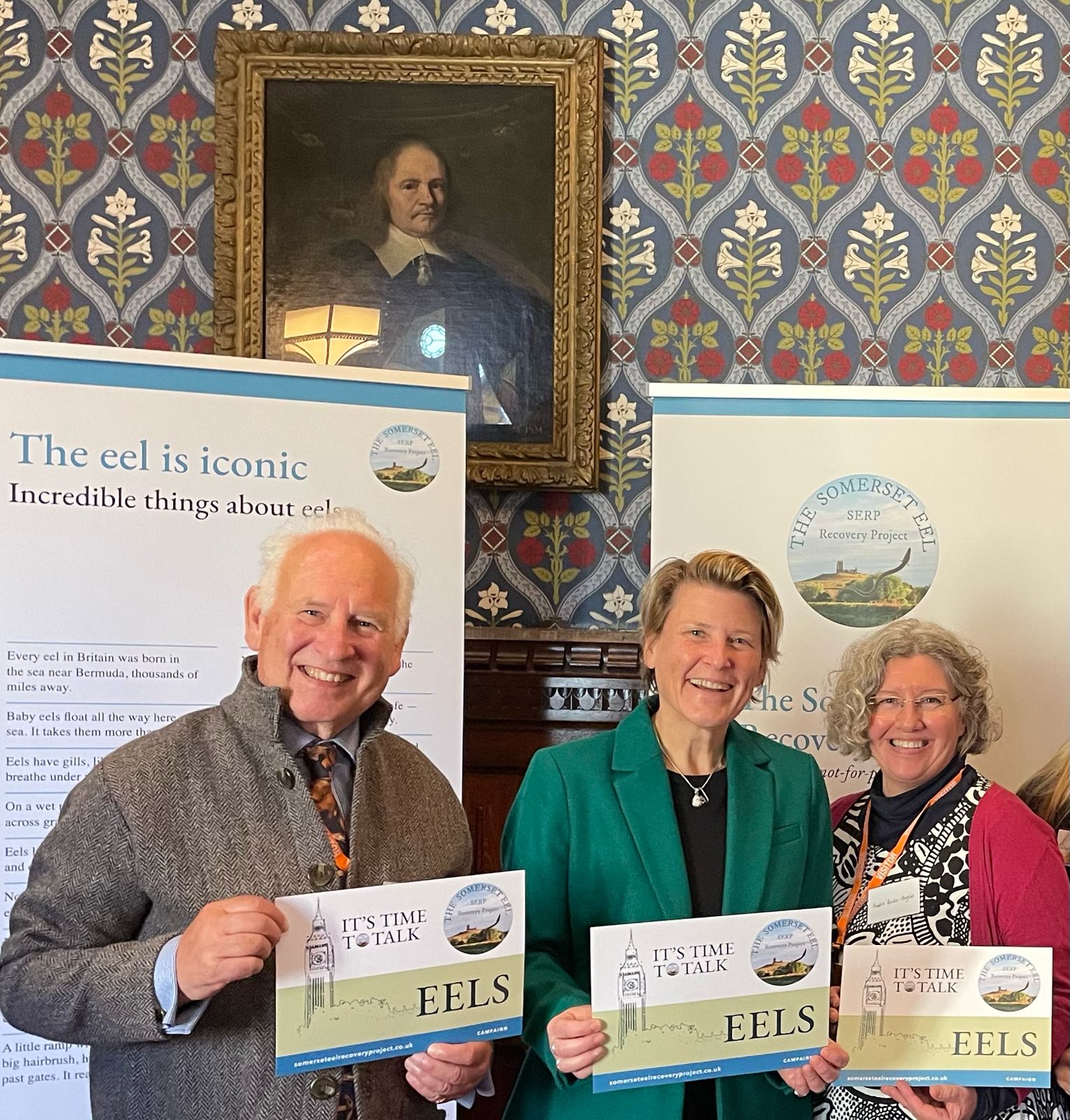
Sustainable Eel Group joins SERP at the Palace of Westminster
Last week, the Somerset Eel Recovery Project took its work to the centre of British politics with an event at the Jubilee Room in the Palace of Westminster. Hosted by Sarah Dyke MP, Liberal Democrat MP for Glastonbury and Somerton, the event creating an opportunity to bring the challenges facing the European eel directly to policymakers and demonstrate how local action can contribute to more comprehensive nature recovery. For the Sustainable Eel Group, the event was an opportunity to highlight the multiple dimensions of SERP’s approach, from campaigning for improved eel passage at key sites in Somerset to engaging schools and communities in understanding the importance of this remarkable migratory fish. But the discussion also brought into focus a fundamental policy question: how can the needs of the European eel be better served in the decisions that shape our countryside? Eel recovery cannot be separated from the management of rivers, infrastructure and land, nor can it rely on conservation organisations working in isolation from the people and institutions whose decisions influence the environment. By bringing SERP’s experience in practical and community-led conservation to Westminster, the event provided a platform from which to make the argument that local projects should have a voice in the national conversation.
An important message from SERP’s work to date is that eel conservation requires the ability to bring people together, build understanding and ensure that the species is considered in decisions that affect its natural habitat. This is particularly relevant to land-use planning, where choices about development, infrastructure and the management of land can have implications for rivers and ecological connectivity. SERP’s leading role within the Somerset Eel Working Group is important in this context, providing a collective platform through which the interests of eel recovery can be represented and its political position amplified in planning and other relevant decision-making processes. By helping to bring eel conservation into wider discussions about land use, the group can strengthen the connection between ecological evidence, local priorities and the decisions that ultimately shape the landscape. The significance of this work is in ensuring that the requirements of the European eel are recognised early enough to inform decisions and that seasonal changes only local people would notice are noted down rather than being considered only after choices have already been made. The Westminster event offered an opportunity to draw attention to this role and to underline why effective recovery requires coordination between local conservation initiatives and planners, elected representatives and other decision makers at different levels.
Alongside this policy engagement, SERP have launched an educational programme, which demonstrates how long-term conservation can be supported by helping younger generations understand the species and habitats around them. The project has developed education packs, presentations and resources for different age groups, from early years through to Key Stage 3, giving teachers practical ways to introduce the European eel and its environmental significance in an accessible and engaging form. At Westminster, this work offered an important reminder that the delivery of education and skills policy is not separate from the development of water and environmental policy. There is the potential to extend educational resources to schools across the country wherever eel habitat is present, allowing lessons developed through local experience to benefit a wider network of communities and civil society organisations. Such an expansion could help more children and young people understand the connection between rivers, wildlife and human decision-making, whilst encouraging a sense of responsibility for the environment. For policymakers, the opportunity is to recognise and support approaches that make conservation relevant to everyday life, ensuring national ambitions for nature recovery are accompanied by practical opportunities for people to understand what those ambitions mean in their communities.
SERP’s wider community programme brings that principle to life through activities that invite people to encounter eel conservation in different ways, including traditional crafts such as rush weaving and straw rope making, children’s storybooks and board games, and special events such as conferences and art installations. These initiatives may differ in terms of format and delivery, but each creates an opportunity to make the eel more visible and to bring a wider range of people into the conversation about its future. This matters because conservation challenges can seem distant when they are communicated only through technical reports or policy commitments, whereas creative and community-led activities can make them tangible, memorable and rooted in local experience. They can also help build connections between people who might not otherwise engage with environmental issues, providing a foundation for broader public interest in the health of rivers and the species that depend on them. The presence of this work within the wider story demonstrates that SERP is building the social understanding that can support them. For SEG, this combination of practical action, public engagement and policy advocacy also reflects the interconnected nature of eel recovery; that progress depends on improving the conditions eels encounter in rivers and on ensuring that people understand why those improvements matter.
The need to connect public awareness with practical intervention is particularly clear in SERP’s campaigns for improved eel passage at sites across the west of England, including Gold Corner Pumping Station. Barriers to movement can create significant challenges for migratory fish, and addressing them requires site-specific attention, cooperation and decisions that translate conservation objectives into action. By campaigning on these issues, SERP brings the practical requirements of eel recovery into discussions about infrastructure and river management, helping to identify where action is needed and why it matters. The feedback from Members of Parliament was very positive, suggesting that SERP’s objectives are being received with interest and sympathy. This represents an important step forward for the project and the wider eel conservation community. The purpose of bringing this experience to Westminster was to demonstrate how these different strands of work might complement one another and why locally informed approaches deserve a place in the development and implementation of wider environmental priorities.
The event offered more than an opportunity to showcase a Somerset project; fundamentally, it created a platform to explore how SERP’s experience could inform the wider response to the decline of the European eel. For SEG, the priority is to ensure that the species is considered in decisions affecting its future, from river infrastructure and land-use planning to the education and community engagement needed to sustain long-term support for recovery. SERP’s work through the Somerset Eel Working Group illustrates the value of collective representation in strengthening the position of eel conservation within local decision-making, whilst its educational resources and community activities show how practical action can be supported by wider public understanding. The challenge now is to carry the conversation beyond Westminster, turning the connections made between policy, planning, trade, conservation and public engagement into continued collaboration and action in the eel’s best interest. The European eel may be encountered in local rivers and waterways, but securing its future requires decisions at every level.
The Sustainable Eel Group would like to thank Sarah Dyke MP for hosting the event and providing a valuable opportunity to bring the challenges facing the European eel to Westminster. We are also grateful to Sarah and the Liberal Democrats for their engagement with SERP’s work and their interest in the role that local conservation projects can play in shaping wider environmental priorities. Opportunities such as this are vital in ensuring that the needs of the European eel remain part of the national conversation and that the experience gained through local action helps inform the decisions needed to secure the species’ future.